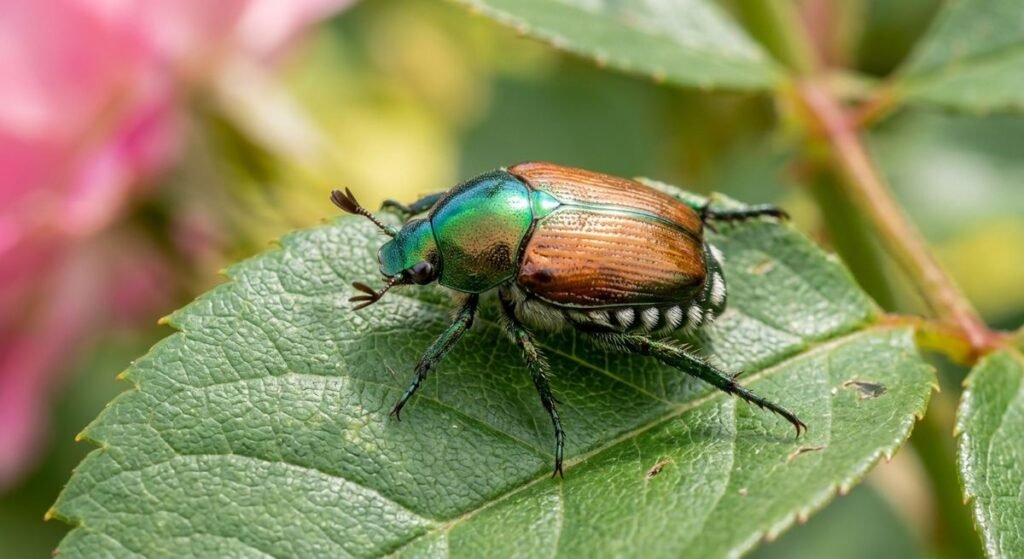
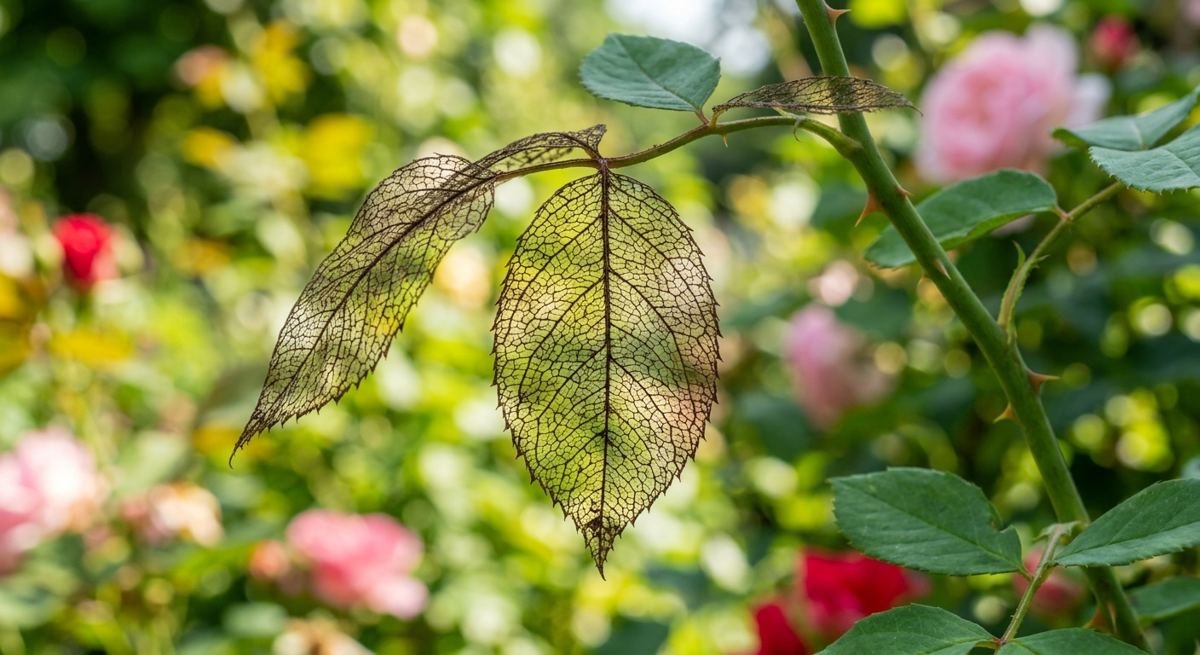
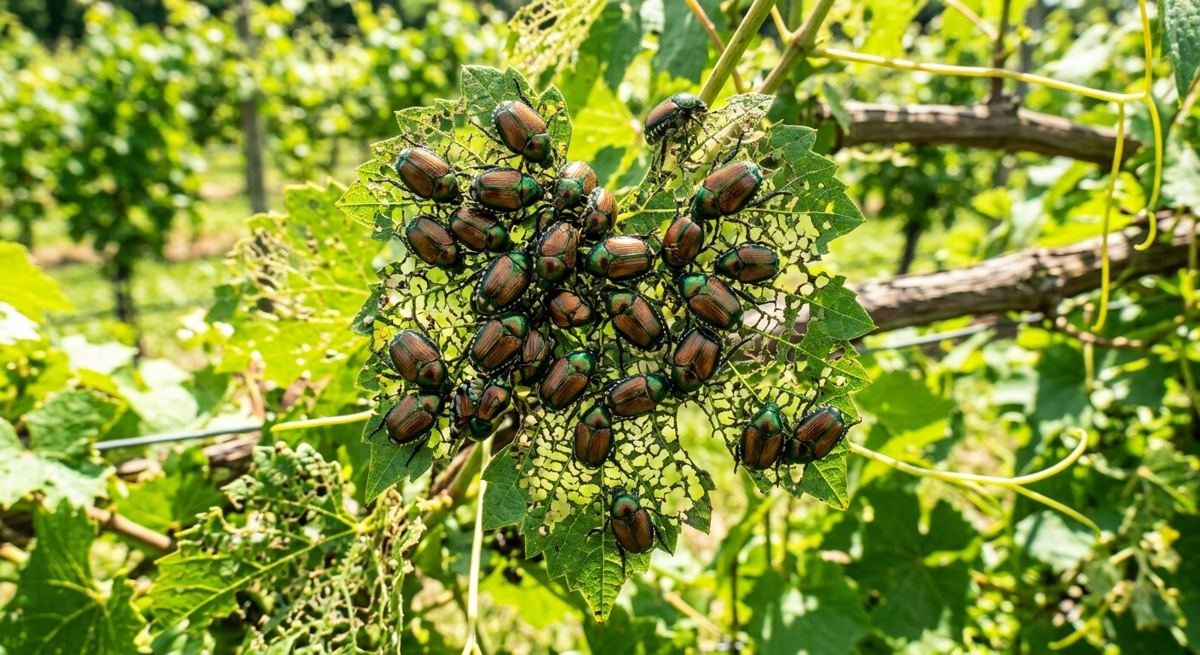
Japanese beetles are among the most visible and destructive garden pests in much of the eastern and midwestern United States, easily recognized by their metallic green-and-copper coloring and their habit of feeding in large groups, which can skeletonize leaves — eating everything but the veins — remarkably quickly once a population takes hold.
How to Identify Japanese Beetles
Adults are about 3/8 to 1/2 inch long, with a distinctive metallic green head and thorax and coppery-brown wing covers. A row of small white tufts of hair along each side of the abdomen, visible on close inspection, helps distinguish them from a few similar-looking beetles. They’re most active on warm, sunny days and tend to feed in clusters, often starting at the top of a plant and working downward.
Signs of Japanese beetle damage:
- Skeletonized leaves — the tissue between veins eaten away, leaving a distinctive lace-like pattern behind
- Damaged flowers, particularly roses, which are among their favorite targets
- Large groups of beetles feeding together, often dozens on a single plant during peak season (typically mid-summer)
- Damaged fruit, especially on thin-skinned fruits like grapes and raspberries
Understanding the Full Life Cycle
Japanese beetles have two distinct management stages: adults on foliage and grubs in soil. Check for damaging grub numbers before treating turf; controlling your lawn’s grubs alone will not stop adults flying in from surrounding areas.
Adults emerge in early to mid-summer, feed for several weeks, mate, and lay eggs in turfgrass and soil, typically in well-watered lawns.
Grubs hatch from these eggs in late summer, feed on grass roots through fall, overwinter deep in the soil, then resume feeding on roots in spring before pupating and emerging as adults to complete the cycle the following summer.
Controlling Adult Japanese Beetles
1. Hand-picking
For smaller infestations or high-value plants, hand-picking beetles directly into a container of soapy water is genuinely effective, especially in early morning when beetles are more sluggish from cooler overnight temperatures and less likely to fly off when disturbed.
2. Avoid Japanese beetle traps
This surprises a lot of people, but most research and extension office guidance actually advises against pheromone traps for home garden use. These traps release a scent that attracts beetles from a wide surrounding area — often drawing in more beetles than they actually catch, meaning a trap can end up increasing the beetle population in your yard rather than reducing it. If used at all, they’re best placed well away from valuable plants, essentially as a decoy rather than a direct control method.
3. Row covers
Covering vulnerable plants with row cover during peak beetle activity (typically several weeks in mid-summer) provides a complete physical barrier, though this isn’t practical for larger plantings or plants that need pollinator access during that window.
4. Insecticidal soap and neem oil
Insecticidal soap alone is generally ineffective against adult Japanese beetles. Labeled neem products may deter feeding when beetle numbers are low, but results vary; they are not a reliable rescue treatment for heavy infestations. Start with hand-picking and barriers, and follow the label for any pesticide.
5. Targeted insecticides for severe infestations
For serious damage on high-value plants, use only products labeled for Japanese beetles and that plant or crop. Follow all pollinator restrictions and harvest intervals. Do not spray open flowers or visiting bees; evening application alone does not eliminate risks from residues.
Controlling Japanese Beetle Grubs
1. Milky spore
Milky spore targets Japanese beetle grubs, but commercial products have not provided consistent benefits in modern university trials. Do not rely on it as a proven, long-lasting solution; ask your local extension service whether any grub treatment is justified.
2. Beneficial nematodes
Microscopic parasitic nematodes, applied to soil (usually mixed with water and sprayed or watered in), actively seek out and kill grubs in the soil. Timing matters — they’re most effective when grubs are actively feeding near the surface, generally applied in late summer to early fall.
3. Grub-specific lawn treatments
Preventive and curative grub products have different application windows. Identify the grubs, assess damage, and follow local extension recommendations and the product label rather than treating a lawn automatically.
4. Reduce watering during egg-laying season
Female beetles preferentially lay eggs in moist soil, particularly in well-irrigated lawns during their egg-laying period in mid-to-late summer. Allowing lawns to dry out somewhat during this specific window (without causing serious lawn damage) can reduce how attractive your yard is for egg-laying compared to a consistently well-watered, lush lawn nearby.
Choosing Less Attractive Plants
Japanese beetles have well-documented preferences, favoring roses, grapes, linden trees, and many fruit trees, among others. Choosing less-favored plants for particularly vulnerable garden areas, or accepting that favored plants will need more active management, is a reasonable long-term strategy where beetle pressure is consistently heavy.
Building a Season-Long Strategy
Early summer (adults emerging): Begin hand-picking or applying row covers to your most valuable plants as soon as beetles appear.
Mid-summer (peak activity and egg-laying): Maintain hand-picking routine, reduce lawn watering during the egg-laying window if practical, and consider beneficial nematode application toward the end of this period.
Late summer to fall: Check for young grubs and turf injury. If control is warranted, use a locally recommended treatment at the appropriate time.
Following spring: Reassess turf health; spring treatments of large, mature grubs are often ineffective and do not prevent adults migrating into the garden.
The Bottom Line
Effective Japanese beetle control starts with monitoring, hand-picking, and barriers to limit adult feeding. Treat lawn grubs only when their numbers and damage justify it; results depend on timing and product choice, and migrating adults can still arrive. Avoid baited traps near valuable plants and protect pollinators when selecting any pesticide.
Related Garden Pest Guides
- Natural pest control for vegetable gardens
- How to get rid of aphids
- Spotted lanternfly identification
Further reading: University of Minnesota Extension: Japanese beetles and Japanese beetle IPM research.
Last modified: October 19, 2026